Investigate failures
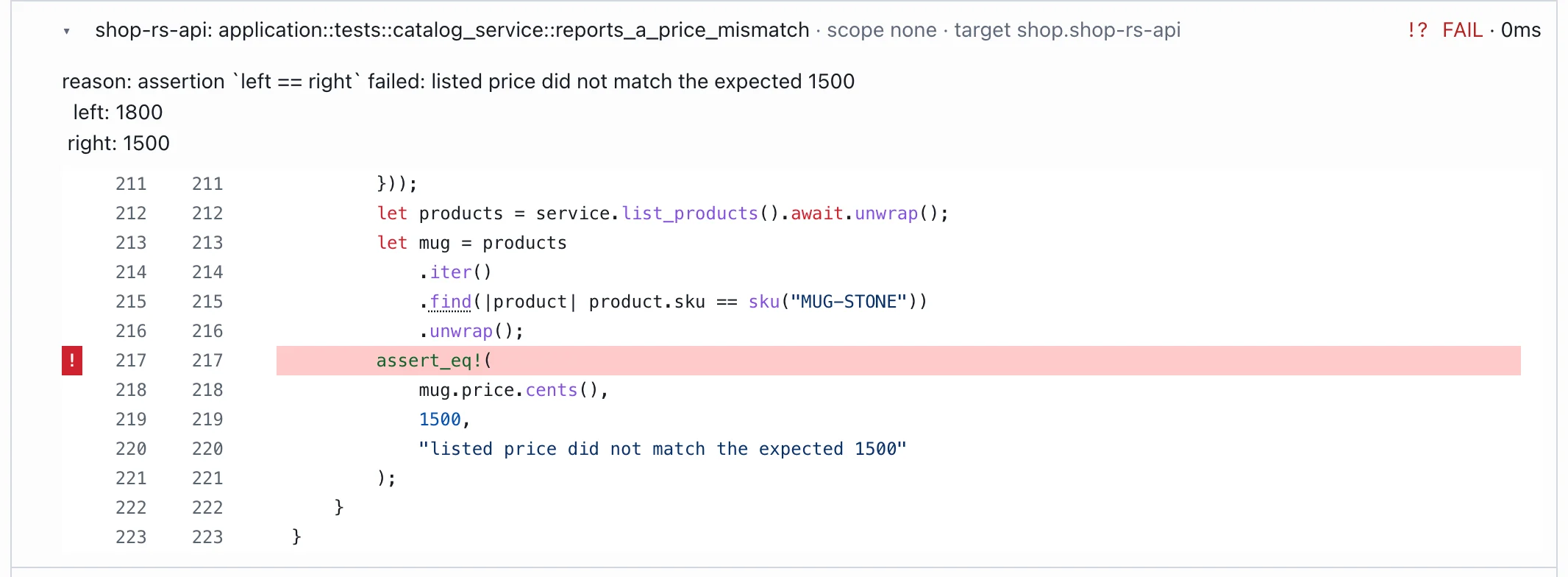
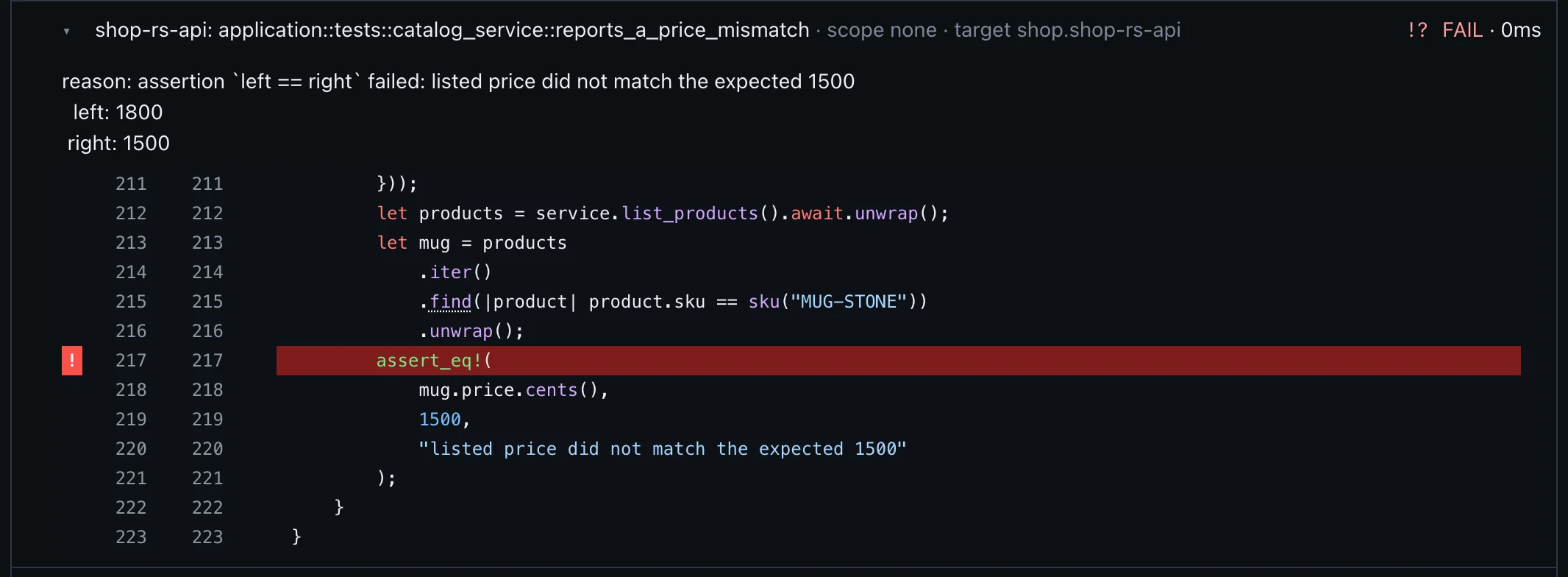
See which tests failed and why. The failing assertion is shown with its code and the failing line marked. Captured requests, screenshots and browser traces are attached when the runner records them.


One feature can touch your frontend, APIs and shared libraries across a monorepo, a multi-repository project or several monorepos. Each component has its own languages, test tools and services. You need to test them together.
Cherry Test coordinates the tests in your configured workspace and brings their results and coverage into one report. Keep your existing test tools. Spend less time running commands and collecting results.
Run locally or in CI.
Generate a cherry-test.yaml file and review the packages it finds. Configure the test suites and services your workspace needs.
Cherry Test runs your configured test tools and starts Docker Compose services for the integration tests that need them.
See passed, failed and skipped tests alongside coverage. Start with the summary, then inspect the details.
Shop is one configuration root, app/shop, with one cherry-test.yaml and one report. That root holds three components: shop-rs-api (Rust, Axum), shop-ts-lib-cart (TypeScript) and shop-ts-web-react (React). Postgres is the Compose database, and the shop_checkout scope starts that stack. Another repository is another --root and its own report.
cherry-test --root app/shop --verbose loads that file, runs Cargo, Vitest and Playwright where each package asks for them, and lists every suite and test at the end. This recording is about 13 seconds. The real run takes about two minutes, mostly while Docker builds the API. The sample report stays on its own button.
The recording could not be loaded. Open the sample report to see the results of this run.
cherry-test --root app/shop --verbose.
Open sample report
Shop branch discount adds a catalog discount and touches three components: shop-ts-lib-cart, shop-rs-api, and shop-ts-web-react. A stone mug is seeded at 10 percent off. Two mugs list at 1800 cents and check out at 1620 cents each, 3240 cents together. Cherry Test compared that branch with main on lmrrcc/shop#1.
The run header is FAIL. application::tests::catalog_service::reports_a_price_mismatch still expects a listed price of 1500 cents, and that test’s source file is in this diff. The new mug checkout passed.
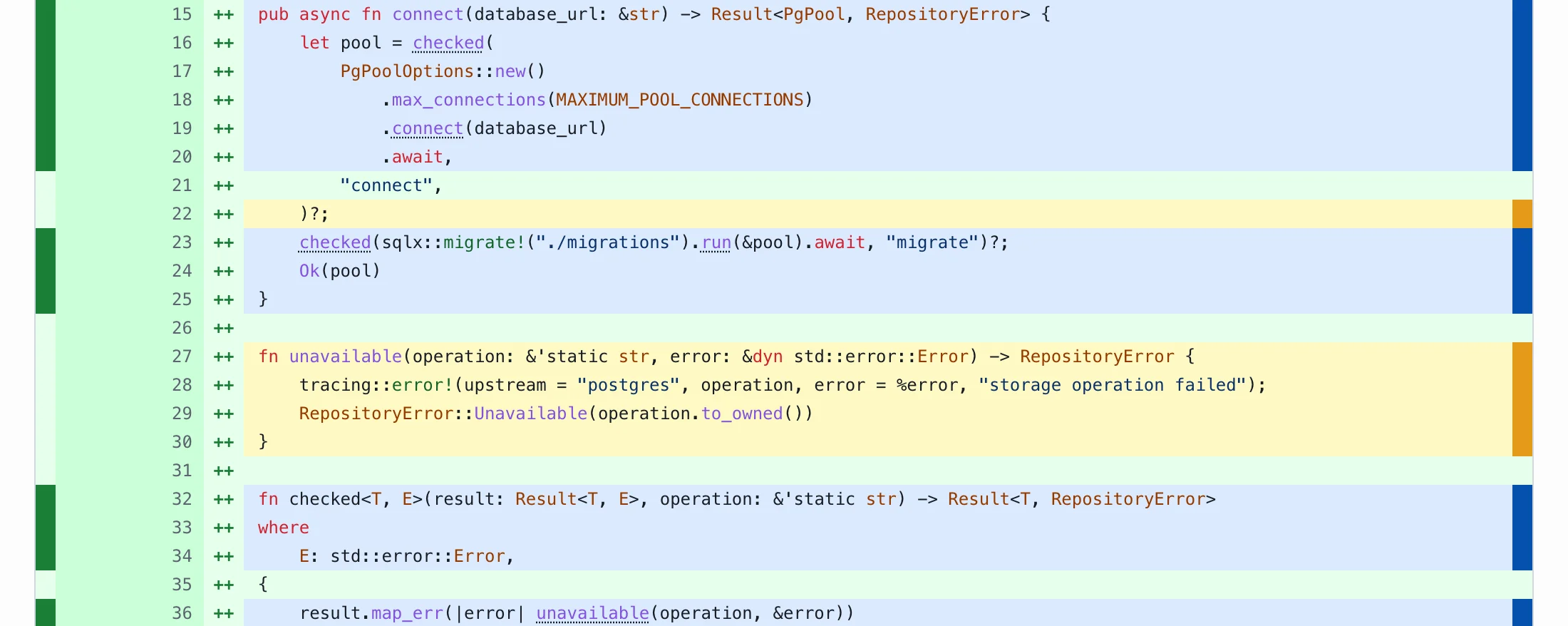
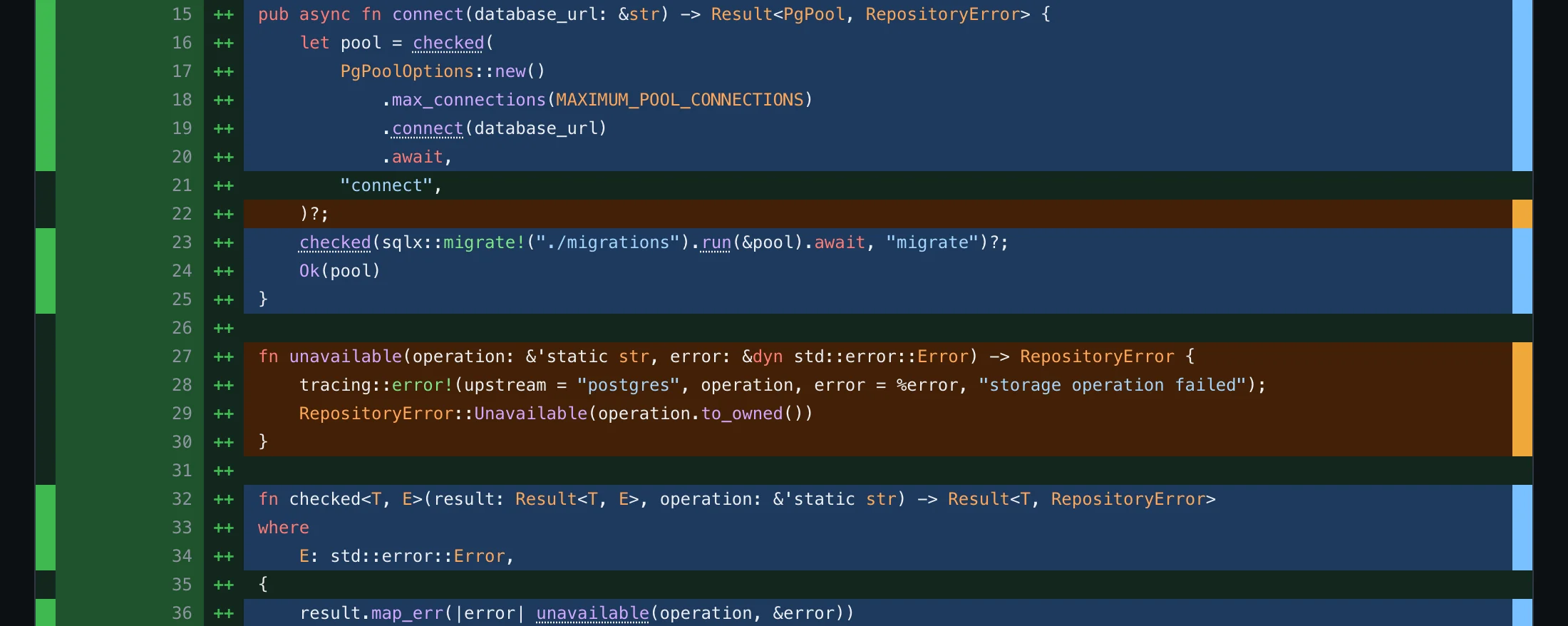
In Changes, a blue rail is a line a test reached and an amber rail is a line it missed. The rejection of a percent outside 0 through 100 is amber in DiscountPercent::parse and in discountedUnitCents.
The report keeps the full test list and the full CRAP list. Tests on this change lists the 13 recorded tests whose source file is in the diff. On this change scores the 24 functions whose lines overlap the added diff. The workspace scores 167 functions. The worst score on the change is 14.7, and none are at or above 30.
20261009-115357-0b2948 of cherry-test --root app/shop.
Open the change report
View the pull request
See which tests failed and why. The failing assertion is shown with its code and the failing line marked. Captured requests, screenshots and browser traces are attached when the runner records them.
View code changes alongside coverage. Lines your tests reached are marked blue, lines they missed are marked amber, so untested changes stand out.
Every suite and test on one page, with totals and timings. Filter by text, tag or status, and sort by duration. Open it locally or save it as a CI artifact for your team.
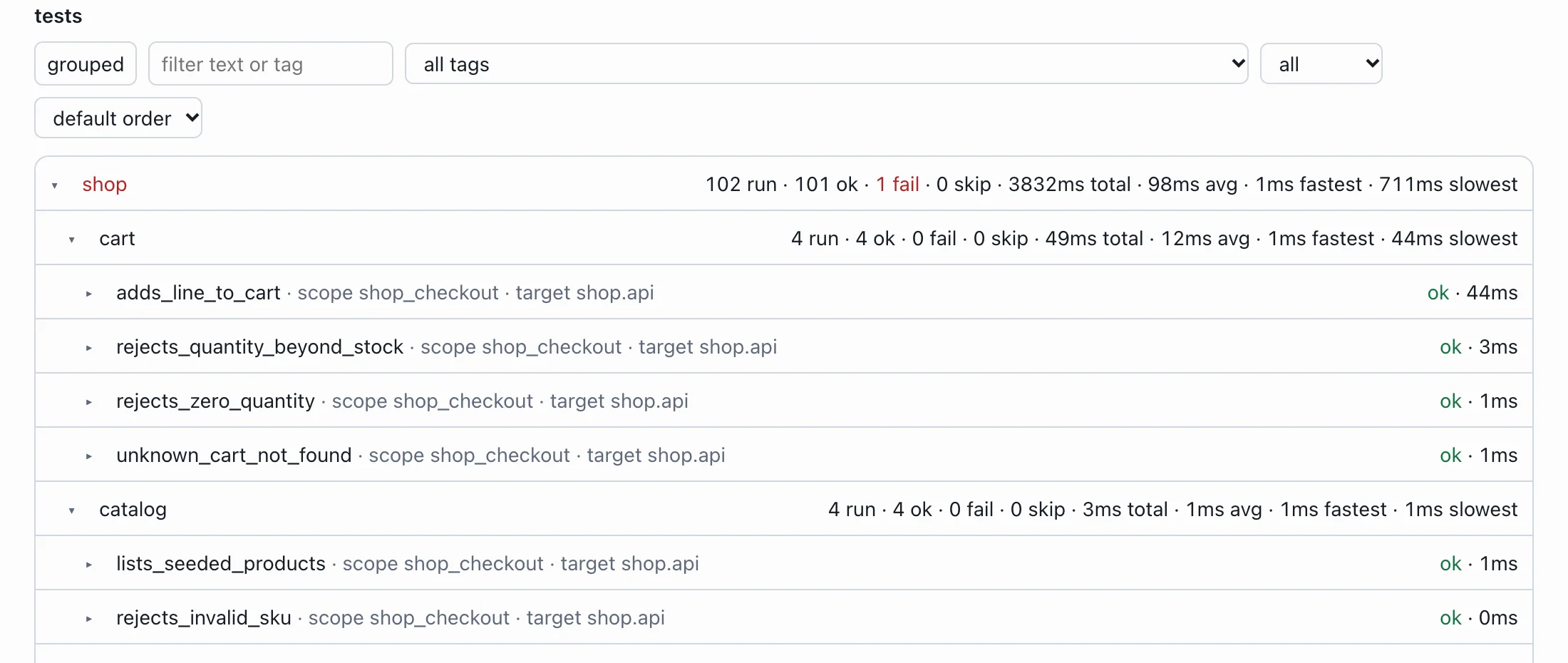
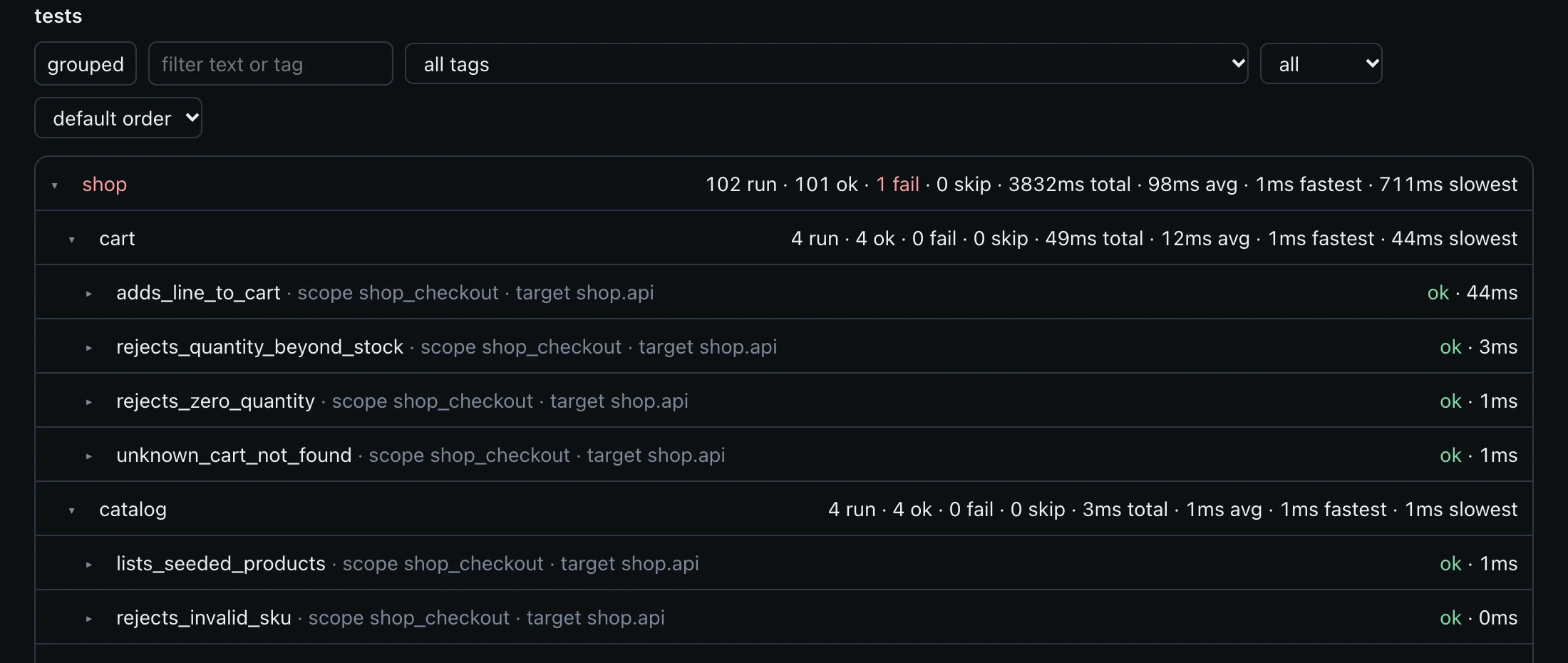
The CRAP score combines each function’s complexity with how much of it your tests cover. The riskiest functions come first, coloured by severity, and each one opens to show exactly which lines no test reaches.
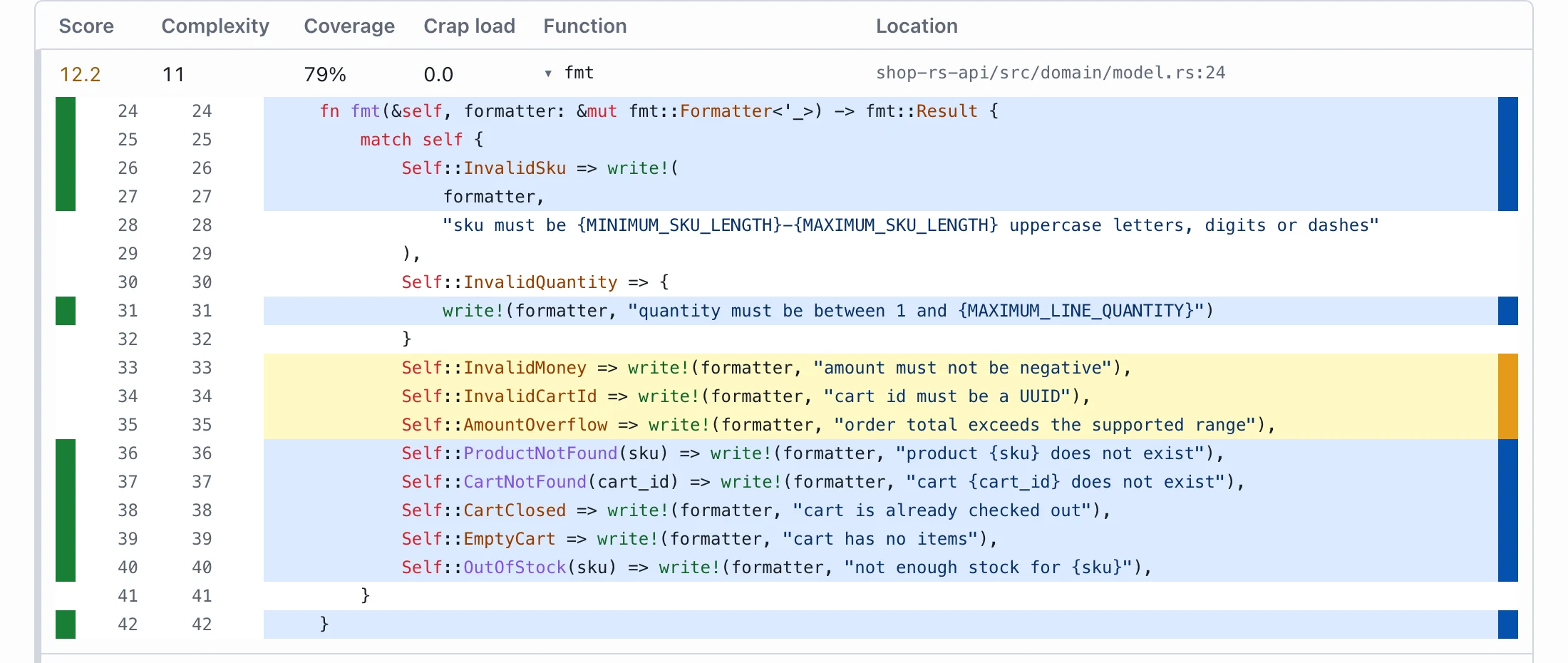
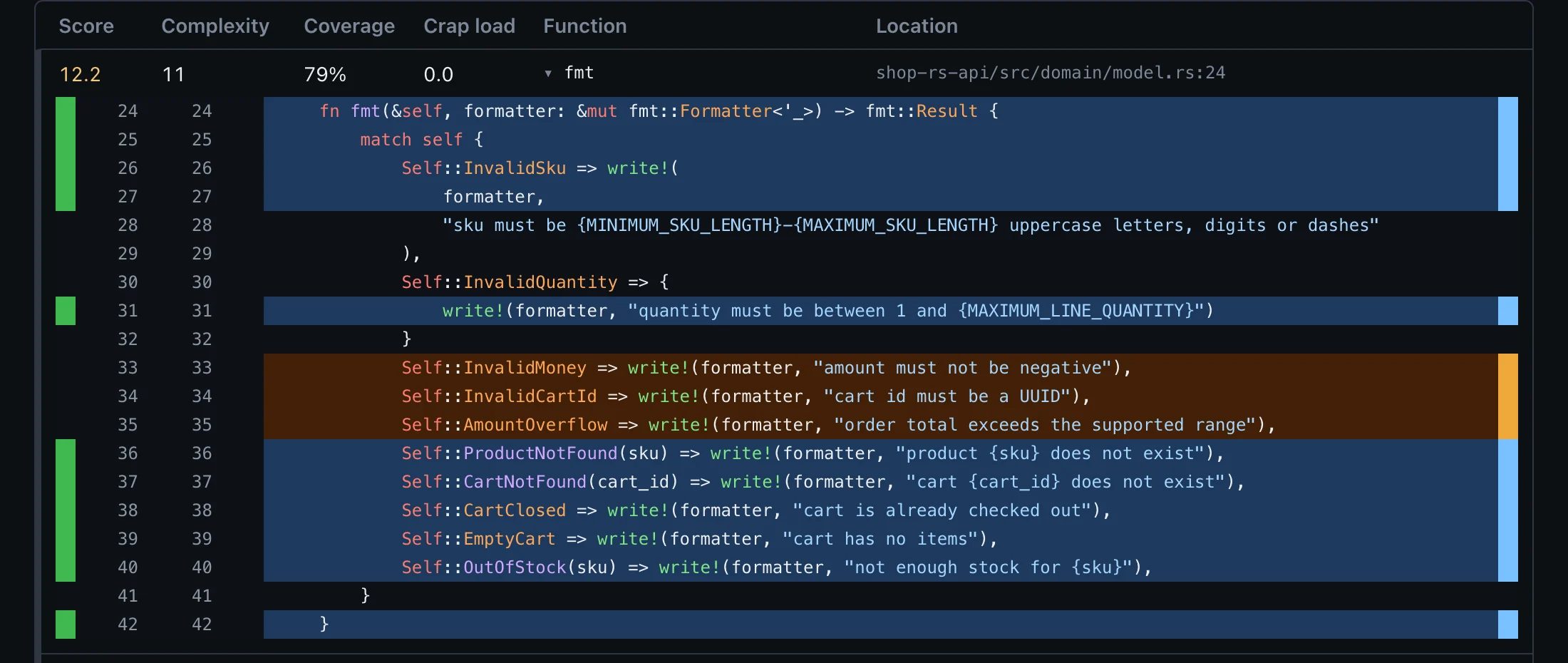
Follow the installation guide, then generate a configuration and run your tests.
Cherry Test prints a summary in your terminal and opens the report in your browser.
Each configuration root has its own run and report. Independent workspaces are run separately.
Cherry Test is in early development. If something doesn’t work for your project, tell us about it on GitHub.
Generate cherry-test.yaml from the packages and services Cherry Test finds.
$ cherry-test --init-only
Review the packages, test suites and services in cherry-test.yaml. When you’re ready, run:
$ cherry-test
Installation, configuration, integration tests, coverage, CI and the command reference. Each configuration root has its own run and report.
A change in one service can break another package. Cherry Test runs those parts in one configured flow: mixed languages, nested Git checkouts, Compose services, merged LCOV against a Git base, and a report a reviewer can open without an IDE.
| Area | Support today |
|---|---|
| Rust | Unit and integration tests through Cargo. Coverage through cargo-llvm-cov. |
| JavaScript and TypeScript | Vitest tests, JSON results, and LCOV coverage. |
| Java and Kotlin | Maven or Gradle, JUnit XML, and JaCoCo source coverage. |
| C and C++ | CMake/CTest, Unity or GoogleTest, and LLVM source coverage. |
| React and Vue | Vitest unit tests, plus Playwright functional tests and screenshots. |
| Browser tests | Playwright results, screenshots, expected/actual/diff images, and trace attachments. |
| Other commands | A functional runner launches an external command and reads its exit status. |
| Test containers | Docker Compose starts the stacks named by a scope. |
| Mocks | Use the test framework's mocks, or run a mock server as a Compose service. |
| Reports | Terminal summary, HTML report, LCOV files, and recorded integration requests. |
| Mutation testing | Run an external tool beside Cherry Test. The HTML report has no mutant results. |
| CRAP scoring | Calculated on a normal run from cyclomatic complexity and line coverage. --no-crap skips it. |
Adapters run local tools or container toolchains. An external executable adapter can add a language without rebuilding Cherry Test. See the adapter guide and the six-backend price sample.
Release 0.3.16 ships prebuilt cherry-test and cargo-cherry-test for macOS on Apple Silicon. Other platforms build from source. Cargo's binary directory, usually ~/.cargo/bin, needs to be on PATH when you install with Cargo.
cherry-test-0.3.16-aarch64-apple-darwin.tar.gz7.6 MB · unsigned build3be05cd7…09e2bafaSHA-256 of the archiveVerify the checksum, unpack both binaries into ~/.local/bin, and clear the quarantine attribute. Running the binary does not need a Rust toolchain.
$ shasum -a 256 -c cherry-test-0.3.16-aarch64-apple-darwin.tar.gz.sha256
$ tar -xzf cherry-test-0.3.16-aarch64-apple-darwin.tar.gz
$ mkdir -p ~/.local/bin
$ mv cherry-test-0.3.16-aarch64-apple-darwin/cherry-test cherry-test-0.3.16-aarch64-apple-darwin/cargo-cherry-test ~/.local/bin/
$ xattr -d com.apple.quarantine ~/.local/bin/cherry-test ~/.local/bin/cargo-cherry-test 2>/dev/null; cherry-test --version
$ cargo install --git https://github.com/lmrrcc/cherry-test --branch main --locked --bins cherry-test
$ git clone https://github.com/lmrrcc/cherry-test.git
$ cd cherry-test
$ cargo install --path test/cherry-test --locked --bins
$ cargo cherry-test
Inside this checkout, cargo cherry-test runs from source without a separate install. A hosted script is also published at https://lmrr-cc.pages.dev/install/cherry-test.sh.
The binary runs without Rust. Coverage, Node packages, and containers need the tools for the packages you actually select.
| Tool | When you need it |
|---|---|
| Rust and Cargo | To build Cherry Test from source and to run Rust packages. |
| Git | To discover changed files and compare a branch. |
| Node.js and a package manager | To install and run Vitest or Playwright packages. |
cargo-llvm-cov and LLVM tools | To collect Rust coverage. |
| A Vitest coverage provider | To collect Node coverage. Match its version to Vitest. |
| Docker with Compose | To start the configured service stacks. |
| A web browser | To open the HTML report. CI can skip the automatic open. |
$ cargo install cargo-llvm-cov --locked
$ rustup component add llvm-tools-preview
Install Node dependencies before the run, for example pnpm install in a pnpm workspace. Browser tests also need the browsers named by the Playwright config.
The updater and install.sh default to lmrrcc/cherry-test. --repo or CHERRY_TEST_REPO selects another checkout.
$ cherry-test update --repo https://github.com/lmrrcc/cherry-test --branch main
--init-only writes cherry-test.yaml from discovered packages and services. Review paths, kinds, and scopes before the first full run. Running with no configuration file creates one and starts the tests in the same invocation.
$ cherry-test --init-only
$ cherry-test
$ cherry-test --no-open
Coverage and the browser report are on by default. --no-open leaves the report on disk. With the default paths, open target/cherry-test/latest/reports/index.html. The terminal prints the same path.
Prebuilt binaries attached to tagged releases. Generated 2026-10-08 from the repository.
A multi-repository workspace is several checkouts side by side. Cherry Test reads one cherry-test.yaml per run and writes one report for that root. Shop is the separate lmrrcc/shop repository, checked out at app/shop. That root holds a Rust API, a TypeScript cart library, a React storefront, and Postgres.
Cargo.toml · docker-compose.test.yml · pnpm-workspace.yaml
scope shop_checkout starts the stack, then tests call service "api" on port 3000
A payments service, or any other Git checkout with its own Cargo workspace, stays outside shop. Run cherry-test --root there. That run writes its own report. Cherry Test does not clone repositories or merge those reports into shop.
app/shop/
├── Cargo.toml                  members = ["shop-rs-api", "tools/shop-adapter"]
├── docker-compose.test.yml     shop-rs-api + shop-db
├── cherry-test.yaml
├── pnpm-workspace.yaml         shop-ts-lib-cart, shop-ts-web-react
├── tools/shop-adapter/         integration, functional, and visual
├── shop-rs-api/
│   ├── Dockerfile
│   ├── src/domain/
│   ├── src/application/
│   ├── src/infrastructure/     postgres, web
│   └── tests/integration.rs
├── shop-ts-lib-cart/
│   ├── package.json
│   ├── vitest.config.ts
│   └── src/cart.ts
└── shop-ts-web-react/
    ├── package.json
    ├── vite.config.ts
    └── src/Shop.tsx
Shop is its own Git repository, with one Cargo workspace and one pnpm workspace. It is the shape of a configuration root you keep next to other repositories.
Rust packages in one run have to be reachable from that root's Cargo workspace. Setting manifest helps discovery. It does not point the Rust runner at a different workspace. Give each independent Rust workspace its own cherry-test.yaml and invoke it with --root.
$ cherry-test --root app/shop --no-open
$ cherry-test --root /path/to/payments --no-open
Put cherry-test.yaml beside the workspace it describes. manifest, compose, and runner cwd paths are relative to that file. Package names match the Cargo or npm manifest. Compose service names match docker-compose.test.yml.
defaults:
  coverage: true
  html_report: true
  runs_base: target/cherry-test/runs
  scope: global
  diff_base: main

adapters:
  shop:
    command: cargo
    args: [run, --target-dir, target/adapter, -p, shop-adapter, --quiet, --]
    timeout_secs: 1800

projects:
  shop:
    path: .
    diff_base: main
    compose: docker-compose.test.yml
    packages:
      shop-rs-api:
        kinds: [unit, integration]
        integration:
          adapter: shop
          scope: shop_checkout
      shop-ts-lib-cart:
        runtime: node
        manifest: shop-ts-lib-cart/package.json
        kinds: [unit, integration]
        unit:
          command: pnpm
          args: [exec, vitest, run, --coverage, src]
          cwd: shop-ts-lib-cart
        integration:
          command: pnpm
          args: [exec, vitest, run, --coverage, integration]
          cwd: shop-ts-lib-cart
      shop-ts-web-react:
        runtime: node
        manifest: shop-ts-web-react/package.json
        kinds: [unit, functional, visual]
        unit:
          command: pnpm
          args: [exec, vitest, run, --coverage]
          cwd: shop-ts-web-react
        functional:
          adapter: shop
          scope: shop_checkout
        visual:
          adapter: shop
          scope: shop_checkout
    services:
      api:
        service: shop-rs-api
        port: 3000
        health: /health
      db:
        service: shop-db
        port: 5432
        kind: postgres

scopes:
  shop_checkout:
    projects: [shop]
| Setting | Meaning |
|---|---|
defaults.coverage | Collect coverage. Default true. |
defaults.html_report | Write the browser report. Default true. |
defaults.open_report | Open the report after a local run. Default true. Shop omits it and keeps the default. |
defaults.runs_base | Run directory. Default target/cherry-test/runs. |
defaults.diff_base | Git ref to compare. Default main. A project can override it, including inside a nested repository. |
defaults.scope | global, none, a project id, or a named scope. |
defaults.coverage_ignore | Exclusion file. Default .coverageignore. |
packages.<name>.kinds | unit, integration, functional, visual, ui, or mutation. mutation runs only when --kinds names it. CRAP is calculated on a normal run. --no-crap skips it. |
scopes.<name>.projects | Projects whose Compose stacks that scope starts. |
cherry-test.yml and cherry-test.toml are accepted. --init-only scans six directory levels for Cargo, Vitest, Maven, Gradle, and CMake packages, common Compose filenames, and #[cherry_test] scopes. It skips .git, target, and node_modules. --force-init rewrites cherry-test.yaml; review that diff. For an unusual layout, edit the file and pass --root.
A functional or ui block uses command, args, and cwd, and the kind has to appear in kinds. Set adapter: playwright on a browser phase to import results and screenshots. Strict runs require individual test results. The command adapter's exit-status check is for non-strict runs.
Cherry Test passes VITEST_JSON_REPORT and, when coverage is on, VITEST_COVERAGE_DIR. The cart library and the React storefront write both into the current run. The Node runner uses the Vitest installed in cwd. Functional and visual phases run Playwright through the shop adapter. Browser coverage from those phases is merged with the storefront unit LCOV, and with the cart library the page imports.
import { defineConfig } from "vitest/config";

const jsonReport = process.env.VITEST_JSON_REPORT;
const coverageDir = process.env.VITEST_COVERAGE_DIR;

export default defineConfig({
  test: {
    environment: "node",
    reporters: jsonReport ? ["default", "json"] : ["default"],
    outputFile: jsonReport ? { json: jsonReport } : undefined,
    coverage: {
      provider: "v8",
      enabled: Boolean(coverageDir),
      reportsDirectory: coverageDir ?? "coverage",
      reporter: ["lcov", "text"],
    },
  },
});
Scoped integration tests start Compose with up -d --build --wait. Cherry Test reads the mapped ports and tears the stacks and their volumes down afterwards. Shop publishes container ports without a fixed host port. The API image waits for shop-db, then wget checks /health. Database credentials come from SHOP_DB_* in .env.
When Docker is unavailable, scoped integration tests are recorded as skipped. A non-strict run can still succeed. --strict fails the run when a required test is skipped. Check Docker before CI starts.
Add TestEnv with these dev-dependencies. The macro uses tokio and anyhow in the package under test. In this checkout, shop-rs-api points cherry-test-core at test/cherry-test-core instead of the git source. Commit the lockfile.
[dev-dependencies]
anyhow = "1"
cherry-test-core = { git = "https://github.com/lmrrcc/cherry-test", branch = "main" }
tokio = { version = "1", features = ["macros", "rt-multi-thread"] }
The checkout test opens a cart, adds three units of NB-DOT-A5, posts checkout, and checks the order total and the stock decrease. Names follow {project}_project_{suite}_suite_{test}_test. The macro requires an async function, one env: TestEnv argument, and no declared return type. ? is allowed in the body. Ordinary cargo test sees these tests as ignored. Cherry Test selects them in the integration phase. The React storefront covers the same API again with functional tests and visual snapshots: the catalog, cart lines, checkout, and the rejection cases.
use cherry_test_core::prelude::*;

#[cherry_test(scope = "shop_checkout")]
async fn shop_project_checkout_suite_places_order_and_decrements_stock_test(env: TestEnv) {
    let stock_before = stock_of(&env, "NB-DOT-A5").await?;
    let cart_id = open_cart(&env).await?;
    add_item(&env, &cart_id, "NB-DOT-A5", 3).await?.assert_status(200);
    let response = env
        .project("shop")
        .service("api")?
        .post(&format!("/v1/carts/{cart_id}/checkout"))
        .send()
        .await;
    response.assert_status(201);
    let order = response.response_body_json()?;
    assert_eq!(order["total_cents"], 4200);
    assert_eq!(stock_of(&env, "NB-DOT-A5").await?, stock_before - 3);
}
Use framework mocks for a timeout or an unavailable third-party API, or add the mock server to Compose. Cherry Test runs the tests and services you configure. For a full path, run the real API and database, and add browser tests when the UI is part of the flow. A mocked dependency checks the behavior that mock represents.
Rust coverage comes from cargo-llvm-cov, Node from Vitest, JVM from JaCoCo, and C/C++ from LLVM. Cherry Test converts those into LCOV and summarizes by package, project, and phase. The HTML file carries its own styles, so reading it needs no IDE and no report server.
| Report area | What you can inspect |
|---|---|
| Run summary | Package status, test counts, coverage, and the run id. |
| Projects | Package results, with unit, integration, and combined coverage. |
| Tests | Pass, fail, and skip, plus timing, filters, and failure reasons. |
| Test details | HTTP records and source snippets when the runner captured them. |
| Changes | Project and file diffs, line numbers, and coverage markers. |
| On this change | Recorded tests whose source file is in the diff, and CRAP for functions whose lines overlap the added diff. The full lists stay in the report. |
Markers distinguish covered lines, uncovered lines, and lines with no coverage data. A covered line still needs an assertion that checks the behavior. Set diff_base to the branch or commit under review, and fetch it first. empty, empty-tree, and root compare the tracked tree with an empty Git tree. Discovery includes commits since the base, staged changes, unstaged changes, and untracked files.
The Shop discount change request is that comparison on a branch that touches the cart library, the API, and the React shop. Open the change report.
defaults:
  diff_base: origin/development

# .coverageignore at the configuration root
**/generated/**
Keep ignore rules narrow. An exclusion changes what the coverage percentage means, so review edits to that file with the tests.
Use the report as evidence before a merge, whether a person or an agent wrote the change. A green exit code covers the packages and phases you selected.
cherry-test --strict --no-open.reports/ and coverage/ from the run directory, including when the step fails. latest is a Unix symlink.$ set -euo pipefail $ export CI=true $ cargo llvm-cov --version $ docker info >/dev/null $ docker compose version $ cherry-test --root app/shop --strict --no-open $ test -s app/shop/target/cherry-test/latest/reports/index.html $ test -s app/shop/target/cherry-test/latest/coverage/merged.lcov
Run that in a fresh checkout with coverage: true and html_report: true. Upload the run's reports/ and coverage/ under target/cherry-test/runs/. From inside app/shop the same files are target/cherry-test/latest/.... --strict rejects failed or skipped tests, empty required phases, missing requested coverage, and invalid adapter results. A normal run reports CRAP. A high score does not fail the run. Minimum coverage and mutation score stay separate required checks. Review edits to tests, ignore files, and package selection along with the product code.
Line coverage can stay high while assertions stay weak. Mutation testing is a separate check. Cherry Test does not create mutants or score them.
A tool changes a comparison, a return value, or an operation, then reruns the tests. A change the tests catch is a killed mutant. A change that leaves the tests passing is a surviving mutant. Some survivors are missing tests. Some do not change observable behavior. Cherry Test starts that tool only when you pass --kinds mutation. Rust uses cargo mutants. C and C++ use Mull. Java and Kotlin use PIT. Node, React, and Vue use StrykerJS with Vitest. Keep that report next to the Cherry Test report and let the mutation tool fail the job.
$ cargo install cargo-mutants --locked
$ cherry-test --root app/mini --kinds mutation --no-open
| Environment | Tool | Sample package |
|---|---|---|
| Rust | cargo-mutants | mini-rs-lib-mcap |
| C | Mull | mini-c-mcap |
| C++ | Mull | mini-cpp-mcap |
| Java | PIT | mini-java-spring-mcap |
| Kotlin | PIT | mini-kotlin-spring-mcap, mini-kotlin-ktor-mcap |
| Node | StrykerJS | mini-ts-lib-price |
| React | StrykerJS | mini-ts-web-react |
| Vue | StrykerJS | mini-ts-web-vue |
Further reading: cargo-mutants, Mull, PIT, StrykerJS, and mutant states.
CRAP (Change Risk Anti-Patterns) combines cyclomatic complexity with coverage. A function with many paths and little coverage scores higher. Coverage in the formula is a fraction from 0 to 1. The original metric uses basis-path coverage, so compare tools only after checking their definition. The aggregate LCOV percentage in the Cherry Test report is not a CRAP score.
CRAP = complexity^2 * (1 - coverage)^3 + complexity

# complexity 10 → 110 at no coverage,
# 22.5 at half coverage, 10 at full coverage
A normal run calculates cyclomatic complexity for each function in measured source and reports CRAP in the terminal and the HTML report. Pass --no-crap to skip that calculation. Complexity starts at 1 and adds one for each if, loop, catch, switch case, match arm, &&, ||, and ternary. Coverage is the fraction of measured lines inside the function, not basis-path coverage. Rust, C, C++, Java, Kotlin, JavaScript, TypeScript, and Vue script blocks are scored. Crap load is 0 when the score is under 30, and complexity * (1 - coverage) + complexity / 30 when the score is at or above 30. A score of exactly 30 counts. The HTML report shows each function's complexity, measured-line coverage, CRAP, and crap load, then the workspace totals: function count, total complexity, total CRAP, mean, median, worst score, the count and percent at or above 30, and total crap load. Those totals are repeated per project when each scored file falls under one configured project path. The terminal prints the workspace totals and at most four of the worst functions, each with one source line, and then the suite summary. Files outside every project are labeled outside projects. A high score does not by itself fail the run.
$ cherry-test --root app/mini --no-open
$ cherry-test --root app/mini --no-crap --no-open
Further reading: Alberto Savoia's CRAP note.
Inside this repository, cargo cherry-test is the same CLI built from source. A filter selects a project id or a package name.
$ cherry-test --root app/shop --no-open
$ cherry-test shop
$ cherry-test shop-rs-api
$ cherry-test --no-coverage --no-open
$ cherry-test -- --nocapture
| Option | Purpose |
|---|---|
<filter> | Select a project id or a package name. shop and shop-rs-api are filters once that root is loaded. |
--root <path> | Select a configuration root. Shop in this repo is app/shop. |
--init-only | Load or create the configuration, then exit. |
--force-init | Regenerate cherry-test.yaml from discovery. |
--no-coverage | Run without collecting coverage. |
--no-crap | Skip cyclomatic complexity and the CRAP report. |
--kinds <list> | Run only these phases. mutation runs only when it is named. |
--no-html | Skip HTML generation. |
--no-open | Write the report and leave the browser closed. |
--no-banner | Skip the startup banner. |
-q, --quiet | Reduce terminal output. |
-- <args> | Forward arguments to Rust's test harness. |
--help | Show the full CLI help. |
Each run has its own directory. Build output can reach several gigabytes, so delete runs you no longer need. When you copy a report, keep adapter results and attachments. Leave rebuildable target/ and build/ trees behind. Keep generated files out of Git. On systems without the latest symlink, use the path printed in the terminal.
target/cherry-test/
  latest -> runs/<run-id>/
  runs/<run-id>/
    coverage/
      <project>/
      merged.lcov
    reports/
      index.html
      phases.html
      integration/*.jsonl
      adapters/<project>/<package>/<phase>/
        request.json
        result.json
        coverage.lcov
    env.json
Files appear for the runners that ran. env.json records the service endpoints the runtime discovered. The runner loads .env.test from the configuration root when that file exists, or from the project-id directory. CI suppresses the automatic browser open.
| Variable | Purpose |
|---|---|
CHERRY_TEST_WORKSPACE_ROOT | Override the configuration root. |
CHERRY_TEST_SKIP_COVERAGE=1 | Disable coverage collection. |
CHERRY_TEST_NO_OPEN=1 | Disable the automatic browser open. |
CHERRY_TEST_SKIP_DOCKER=1 | Skip container startup and use supplied endpoints. Scoped test selection still depends on Docker preflight. |
CHERRY_TEST_{PROJECT}_{SERVICE}_HOST | Service host exported after startup. |
CHERRY_TEST_{PROJECT}_{SERVICE}_PORT | Mapped service port exported after startup. |
CHERRY_TEST_{PROJECT}_{SERVICE}_URL | HTTP service URL exported after startup. |
CHERRY_TEST_RUN_DIR | Current run directory, set by Cherry Test. |
CHERRY_TEST_REPORT_DIR | Current report directory, set by Cherry Test. |
VITEST_JSON_REPORT | JSON output path passed to Vitest. |
VITEST_COVERAGE_DIR | Coverage directory passed to Vitest. |
RUST_LOG | Tracing filter, such as cherry_test=info. |
NO_COLOR | Disable terminal colors. |
| Limit | What to do |
|---|---|
| Docker skips | Unavailable Docker skips scoped integration tests. Confirm those tests ran in CI. |
| Rust coverage | Missing cargo-llvm-cov fails a strict coverage run. A non-strict local run can continue with a warning. |
| Rust test selection | Unit runs use cargo test --lib. Integration runs use ignored integration targets. Doctests and other Cargo targets stay out of that selection. |
| Container coverage | The service image needs instrumentation and collection. Starting a container does not measure coverage by itself. The price sample collects service coverage for integration, functional, and visual phases. |
| Independent Cargo workspaces | Rust execution uses the configuration root's workspace. Separate roots mean separate runs and reports. |
| External results | A custom tool follows the adapter protocol to import tests, coverage, and artifacts. |
--keep-going | It is checked between configuration roots. Inside a root, package processing already continues after a package failure. It is not a general recovery policy. |
| Concurrent container runs | Each CLI run uses its own Compose project name. Compose files also need to avoid fixed host ports and fixed container names. |
| Quality gates | CRAP is reported on a normal run and does not by itself fail the job. Mutation score and a minimum coverage threshold stay external tools or extra CI checks. |
Four crates implement the runner. app/mini is a second sample, in its own Git submodule and Cargo workspace. Read AGENTS.md before changing the code. A wrong success or a missing coverage file can hide defects in every project that uses the runner.